WARRANT Charlie Xray Contact
A 360-degree sensor head on a galvanised pole at a substation at dusk; far away a small drone is marked by a faint tracking ring WARRANT, a Charlie Xray concept

Charlie Xray · In implementation · Dual-use · Munich

WARRANTOne system. Three keys. Monitor — prevent — defend.

A 360° optical head installed on a critical site. The operator invests in it and runs it as a monitoring system: drones in the air, persons and vehicles on the ground, a visible eye-safe boundary in front of the fence. When the police arrive, their key unlocks prevention — against drones, and against a vehicle used as a weapon. When the armed forces are called in, their key unlocks defence. Nobody brings a second system. What the head may do, and what data it may release, is decided by the key in it.

Monitor · prevent · defend The objective is the key, held in custody Effects never directed at persons

In 20 seconds

The three keys in motion

Illustration. Sound: pings rise and quicken as a contact closes in.

01 The problem

The duty to protect and the power to act sit in different hands

Shortly before midnight on 5 August 2026, staff at Leipzig/Halle found a drone parked on the apron carrying a package with a detonator, next to a Ukrainian Antonov AN-124 of the NATO strategic airlift programme. The airport closed completely; a diverting DHL freighter then struck an unidentified object and landed at Hannover with damage to its nose. The airport's own systems had not detected the drone. Since 1 September 2026 the Federal Government attributes the incident to Russia. Two German laws govern what an operator may do about such a flight, and they point in opposite directions.

  1. 01

    The operator is obliged to establish self-protection

    The KRITIS-Dachgesetz entered into force on 17 March 2026. Section 13 obliges operators of critical facilities to take appropriate resilience measures and to provide adequate physical protection of plant and grounds — a duty to do something, not to observe something. The original registration date of 17 July 2026 was struck by an amendment promulgated on 28 July 2026; the clock now starts with the ordinance that identifies critical facilities. The duty is coming, and operators who build now are ahead of it rather than behind it.

  2. 02

    The operator is forbidden to act

    The second amendment to the Air Security Act came into force on 17 March 2026. Private parties may not intercept, jam or destroy a drone; the effect layer remains with the state. Since August, federal and state governments have been examining whether operators or contracted third parties may take on defensive measures — Brandenburg is drafting an entrustment model, Bavaria plans plant security watches. Whatever the answer, it will need hardware that enforces who may do what.

  3. 03

    The authority arrives without the hardware

    The new Federal Police Act, passed by Bundestag and Bundesrat on 25 September 2026, gives the Federal Police explicit powers for technical drone defence; its counter-drone unit is to grow to 300 officers at eight bases. Eight bases for a country of critical sites. Everyone else arrives by road, with their own equipment, at a site they have never surveyed — against a reaction window that Brandenburg's interior minister puts at 60 to 90 seconds.

  4. 04

    The opponent is a service, not a hobbyist

    By early September 2026 the Federal Criminal Police Office had counted 747 suspicious drone sightings with 1,068 flights and more than 165 suspected sabotage cases in that year alone, according to a confidential assessment reported in the press. Geofencing and Remote ID discipline the law-abiding; a state saboteur switches them off. Jamming does not stop an autonomous drone, and standard airport radar barely registers objects this small.

Selected drone incidents against German critical infrastructure, 2024 to 2026
When and whereWhat happenedConsequence
Aug 2024
Brunsbüttel
Weeks of nightly overflights of the ChemCoast Park, an LNG terminal and a decommissioned nuclear plant, by aircraft reaching around 100 km/h. Police drones could not follow. Investigated as agent activity for the purpose of sabotage. No means of interdiction available on site.
Nov 2024
Munich Hbf
A drone caught in the overhead contact line near the main station; the caller fled. Ten platforms closed in the evening peak to prevent a short circuit.
Oct 2025
Munich
Repeated sightings on consecutive days, partly in groups. Helicopters located neither aircraft nor operators. Runways closed for hours across several days, roughly 6,500 people on camp beds. Bavaria requested armed forces support for detection.
5 Aug 2026
Leipzig/Halle
A drone with a detonator placed beside a Ukrainian AN-124 serving the NATO SALIS airlift programme; not detected by airport systems, found by a bus driver. Complete closure of a primary European air freight hub. Attributed by the Federal Government to Russia on 1 September 2026.
1 Sep 2026
Turnow-Preilack
Home-built flying objects steered onto high-voltage lines at a substation in Brandenburg; on the same evening a short circuit on an overhead line near Bergheim. Investigated as sabotage. Energy infrastructure attacked from the air.
23 Sep 2026
Berlin BER
Drone alarm in the evening. All flight operations suspended for about 45 minutes, eight flights diverted to Dresden. The drone was not found.
  1. 17 Mar 2026

    Law in force

    KRITIS-Dachgesetz, Section 13: physical protection of plant and grounds.

  2. Pending

    Ordinance

    Identifies which facilities are critical; draft from May 2026, not yet issued in September.

  3. + 3 months

    Registration

    Operators register with the BBK, which may also register them ex officio.

  4. + 10 months

    Section 13 applies

    Physical protection has to be in place. WARRANT is installed before this date, not after it.

Sources: drohnen.de on Leipzig/Halle; t-online; ZDFheute on attribution; Nordkurier on Turnow-Preilack; ZDFheute on BER; BKA assessment as reported; Borncity on the KRITIS amendment; § 8 KRITISDachG; Federal Government on the LuftSiG; Federal Police Act vote; Euronews on the Federal Police unit; ZfK on the reaction window; Spiegel on Brunsbüttel.

02 The solution

Put the capability on site and let the key decide what it may do

A single head carries the sensing aperture and the beam director on one optical path. What changes between the operator's monitoring, a police intervention and a military defence is not the hardware. It is the key in it.

A · The head

Many small emitters, one beam, one removable objective

Power comes from an array of modest fibre emitters combined into a single beam rather than from one large source. That makes the head cheaper to build, gracefully degradable when a channel fails, and — the decisive part — scalable by exchanging the objective rather than the machine.

  • Coaxial sensing and beam path, no boresight drift
  • Search does not stop while a bearing is engaged
  • Ground movement, ranging and a visible boundary from the same optics

B · The grid

Range and prediction from several heads

One head gives a bearing. Two give a fix. Several give height, speed and a track that survives a head being masked by a cooling tower. From the track history the grid forecasts where the target will be, which is what makes a slow effector viable against a fast one.

  • Overlapping cover removes the shadow behind buildings
  • Track continuity across heads, not per device
  • Data release itself escalates with the key
At night at the foot of the sensor pole, gloved hands open a rugged case holding a precision lens objective
The key arrivesThe police bring their objective to a head that is already mounted, surveyed and tracking. Fitting it is a physical, logged act — and the moment the state's authority begins on site.
Two people each turn a separate key in an open wall safe holding three lens objectives
CustodyThe higher objectives live in a safe on site, opened by two people with two keys. The record of who opened it is the same record that proves which effect was available.
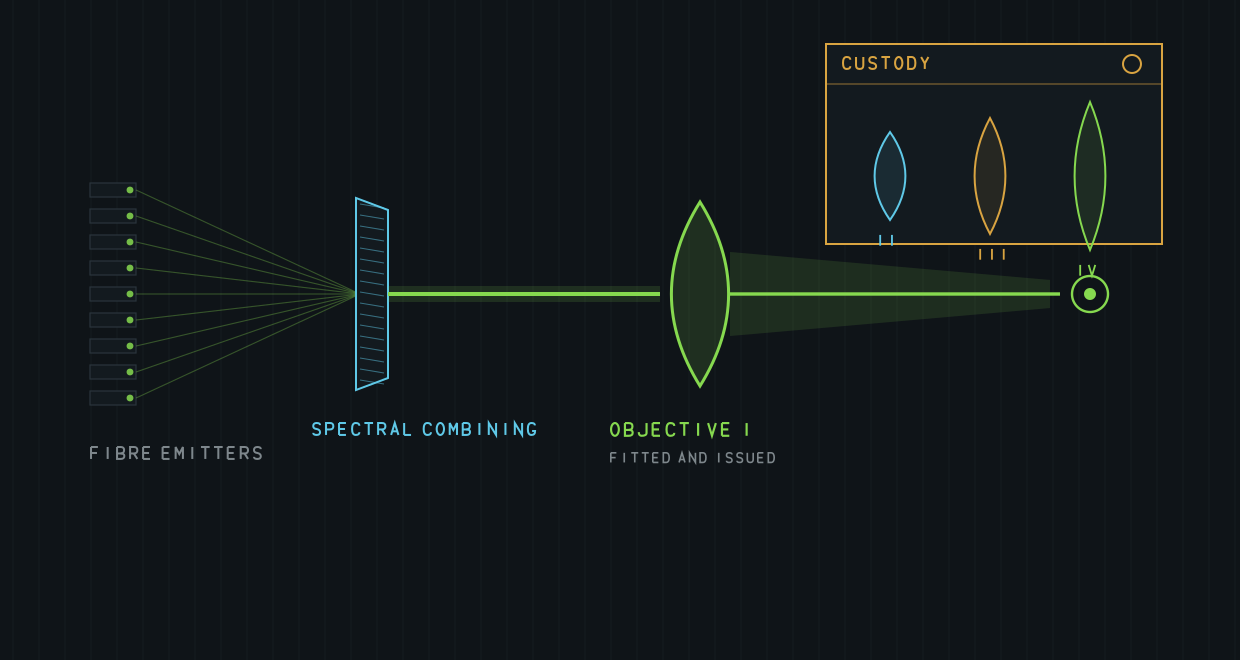
Many small fibre emitters are spectrally combined into one beam. The objective that forms that beam is a removable part held in a safe; a larger objective is what raises the effect tier.
The objective is the key Beam quality and achievable irradiance are set by the aperture that forms the beam. Objective I sits in the head permanently and makes it a monitoring system; the police and armed forces objectives let the same emitters reach further. A permission you can only exercise by physically holding a piece of glass cannot be escalated by a software fault, a misconfiguration or an intrusion.
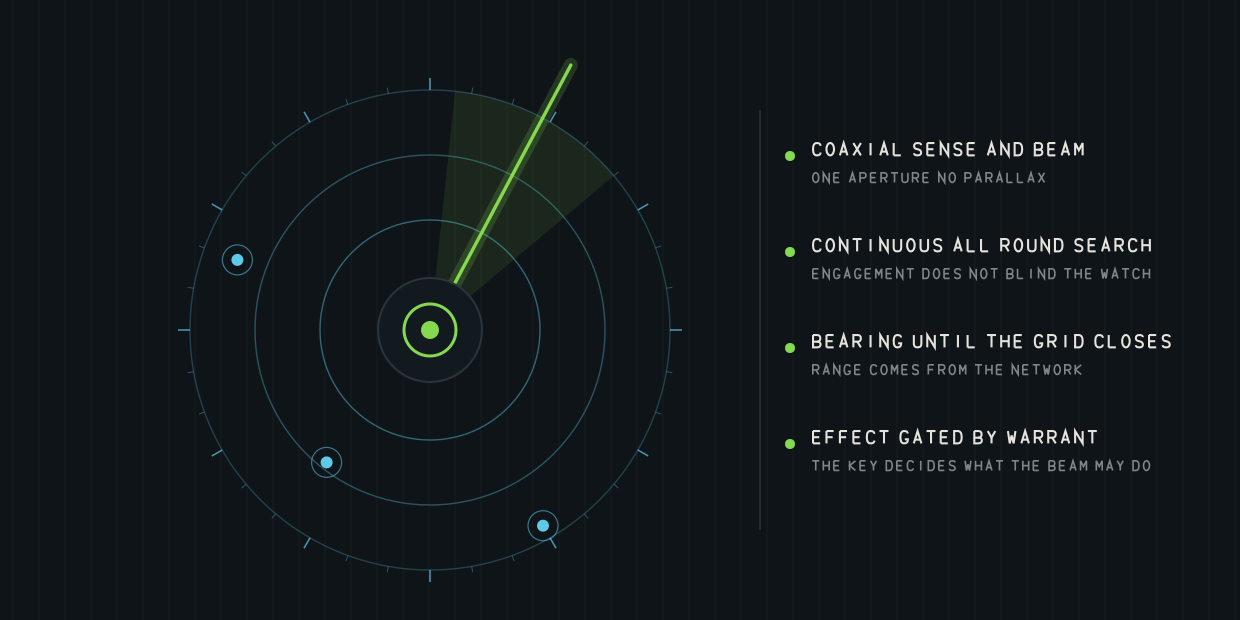
A single rotating head carries the sensing aperture and the beam director. Bearing rings show continuous coverage; one bearing is engaged while the rest keep watching.
The head Engagement must not blind the watch. A system that stops searching while it acts is a system that can be saturated by the second drone — which is how swarms are meant to work.

03 Three keys

One system for every task: monitor, prevent, defend

The operator invests in monitoring because the law obliges them to protect. What they buy is also the pre-positioned capability the state finds already installed when it arrives — and unlocks with its own key.

Plant security control room at night; a screen shows a site map with the track of a drone and the track of a vehicle along the fence

Key 1 · Operator

Monitor

Objective I, issued by the regulatory authority and fitted permanently.

Air
Detect, track and classify drones
Ground
Detect, range and track persons and vehicles; visible eye-safe boundary; light-barrier intrusion detection
Effect
None
Data
Own site picture
An unmarked van with blue lights at the substation gate at night; an officer seen from behind carries a case to the sensor pole

Key 2 · Police

Prevent

The police objective, brought to the site by the federal or state police.

Air
Disrupt, force down, bring down
Ground
Identify persons and vehicles; secure evidence; stop a vehicle used as a weapon — at the vehicle, never at its occupants
Effect
Drones and vehicles
Data
Plus track history and live feed
Dawn at the edge of the site; an unmarked military vehicle by the fence while the sensor head points steeply into the sky at a distant drone

Key 3 · Armed forces

Defend

The armed forces objective, in administrative assistance or in defence.

Air
Defeat drones and loitering munitions
Ground
Site picture for force protection
Effect
Drones and munitions
Data
Plus the grid picture of all heads
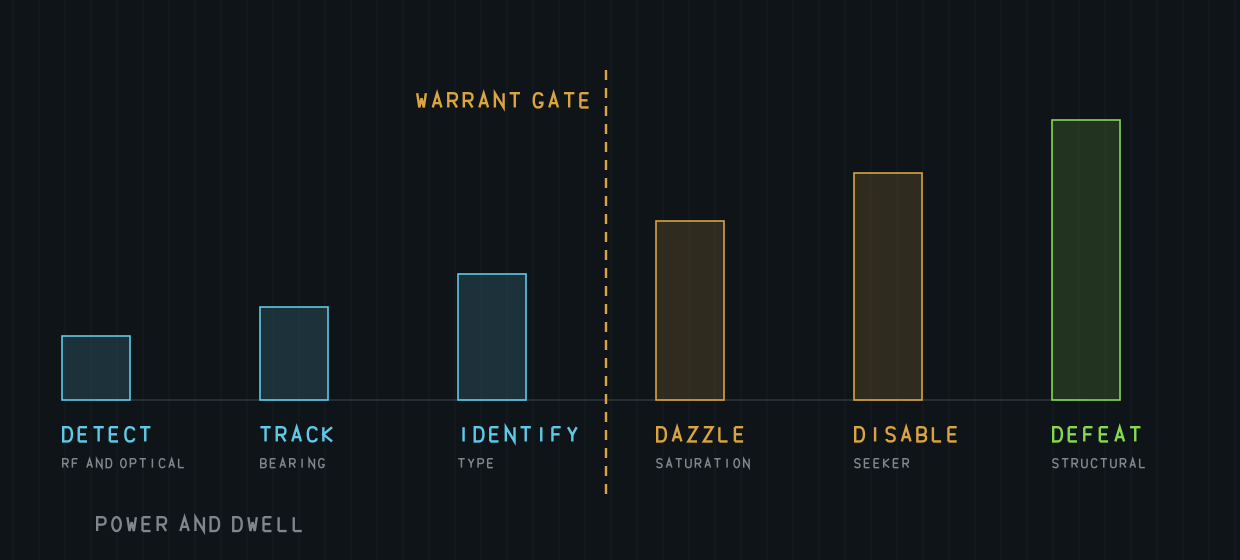
The same emitter runs from detection through tracking and identification to dazzle, disabling and structural defeat. The key gate sits after identification: everything to the right requires a state key.
One beam, six levels The physics is continuous — the same emitter, more power and longer dwell. The law is not, and the gate sits where the law puts it: detect, track and identify belong to the operator's monitoring. Dazzle, disable and defeat require a state key.

Whatever model the law chooses, the key enforces it

Entrustment. Brandenburg is drafting a voluntary entrustment of critical-infrastructure operators with defensive powers, at the operator's cost and with state liability; the bill is to enter interministerial consultation in 2026. Plant security watches. Bavaria plans a state law for plant security units able to defend against drones, modelled on the plant fire brigade. Coordination with the Federal Police. A motion in the Bundestag asks that operators may defend themselves in coordination with the Federal Police. The state on site. Under current law, the police and, on request, the armed forces act.

In every one of these models someone has to prove afterwards who was allowed to do what, at which moment. WARRANT puts that proof into the hardware: the key is the entrustment, made physical. The same installation serves whichever model is enacted, and changes its permissions without a new installation.

Who pays for what

The operator pays for monitoring — the tier that discharges their own duty under Section 13 and follows the EU guidelines that recommend drone detection for critical entities. The state owns and finances the higher objectives, which stay in its custody. The site picture is the second product, offered as a service to the joint counter-drone centre. This answers the energy industry association BDEW, which asks for cost neutrality and clear liability before operators take on any defensive role, and the municipal utilities association VKU, which sees drone defence as a state task.

For the state, coverage appears without a procurement programme. Every protected site becomes a node. By the time the police or the armed forces need to act at a given plant, the aperture is already mounted, already surveyed, already tracking — and already part of a grid whose data they can draw on.

Sources: ZfK on Brandenburg; ZfK on Bavaria; Bundestag hib 703/2026; beck-aktuell on federal deliberations; OpenKRITIS on the CER guidelines; BDEW; Federal Government FAQ on the joint counter-drone centre.

04 How it works

From bearing to fix to forecast

A laser is a precise instrument with an unforgiving requirement: it must know where the target will be, not where it was. Design goals: tracks exported as Cursor on Target (CoT) for TAK clients and, in a defence role, into the Recognised Air Picture (RAP); the optical head built along a modular open systems approach (MOSA), so optics and processors can follow technology refresh cycles without replacing the mast.

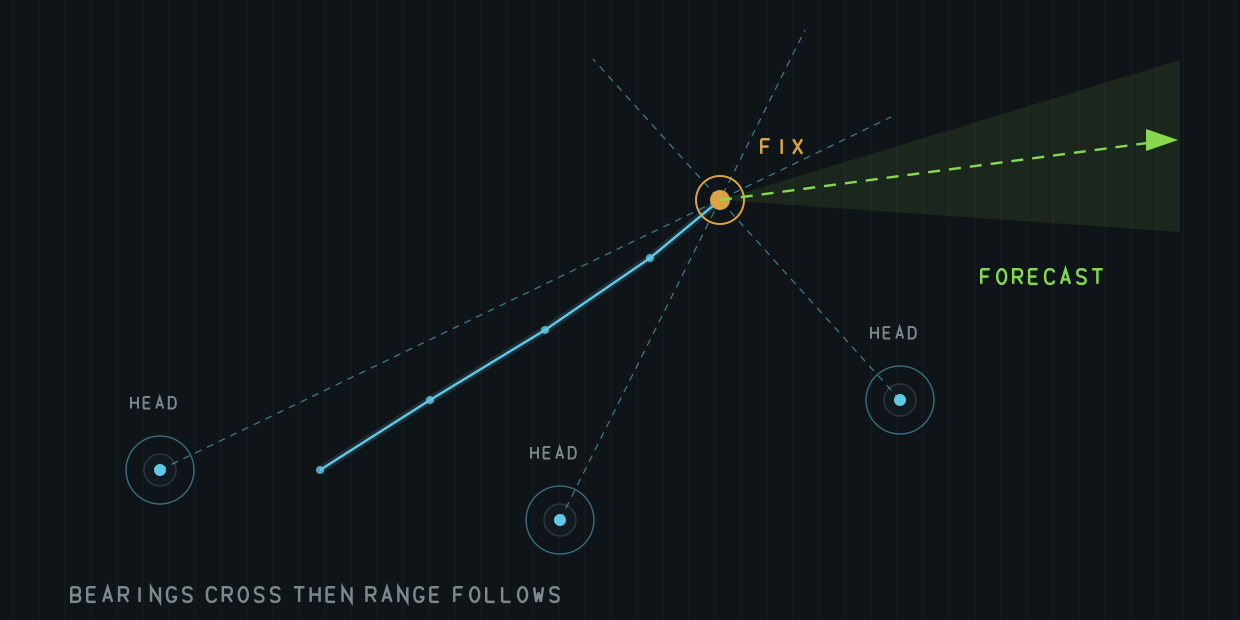
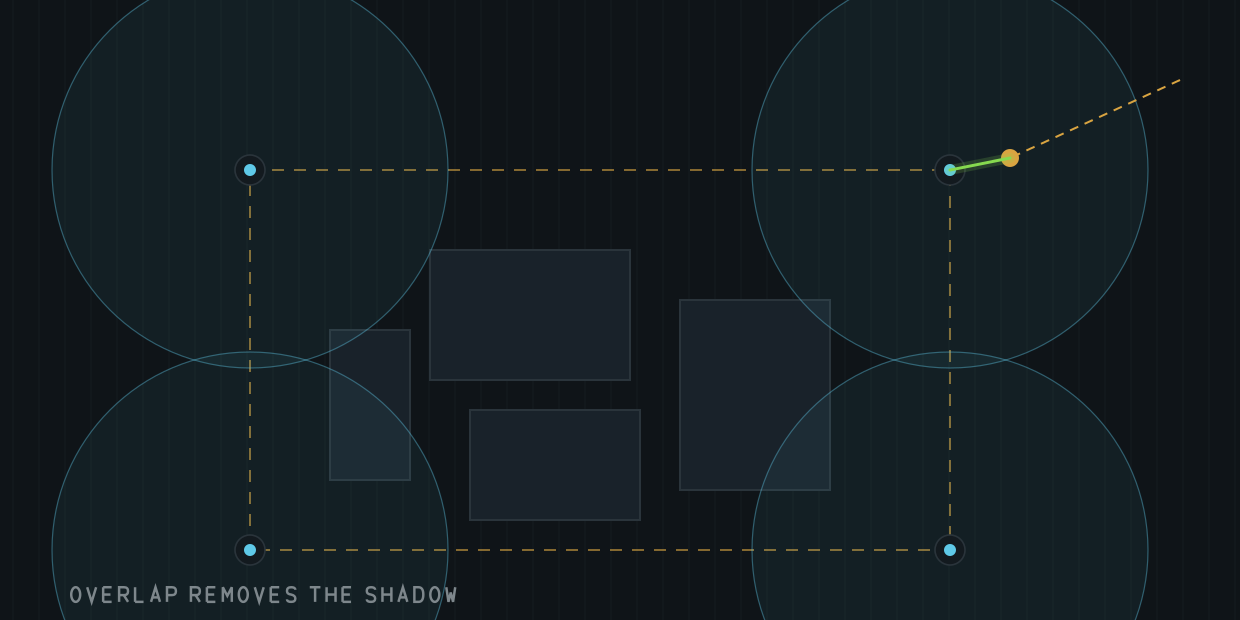
Three heads take bearings on the same target. Where the bearings cross, range and height follow; from the track history a forecast cone extends ahead of the target.
Range from the network Bearings are cheap and passive; range is expensive and usually radiating. Crossing bearings from several heads produces the fix without anyone transmitting, and the track history produces the forecast the beam director actually needs.
Several heads placed around a plant produce overlapping cover. Overlap is what removes the blind sectors that a single mast always leaves behind buildings.
Coverage across a site A single mast on a tank farm sees a cylinder and a shadow. The shadow is where an attacker will fly. Overlap is not redundancy here, it is the whole point — and it is why the unit price has to stay in the range an operator can put several of on one site.
At night a thin green line of light lies on the gravel in front of the substation fence, projected from the sensor head on its pole
The boundaryThe same optics that range a drone lay a visible, eye-safe line on the ground in front of the fence and report who crosses it — the light-barrier principle at the scale of a site. It belongs to the operator's key: it marks, ranges and records. It does nothing to the person.

05 Market environment

A large market, a duty that is coming, and a gap in the middle

All figures are published third-party estimates or official statements. Spreads between publishers in this segment are wide and are shown rather than reconciled.

Why now: capital is moving

USD 7.4 bn

European defence tech venture funding in 2026 to early October, projected USD 10.5 bn for the full year (2025: USD 2.6 bn)

Dealroom × Resilience Media, Oct 2026

USD 3.5 bn

raised by defence start-ups in Germany in 2026, more than any other European country

Dealroom × Resilience Media, Oct 2026

USD 1.2 bn

for counter-drone start-ups in Europe in 2026

Dealroom × Resilience Media, Oct 2026

Source: Dealroom × Resilience Media, The State of Defence Tech 2026 (5 October 2026), via Resilience Media. 2026 figures to early October.

0.5 → 160

EUR m · damage from drone disruption at German airports, 2024 → 2025

DLR · upper estimate incl. network effects

116

partial or full closures at 25 German commercial airports in 2025

DLR, June 2026

1,068

suspicious drone flights over Germany, 2026 to early September

BKA assessment as reported · 747 sightings, 165+ sabotage cases

300 / 8

planned Federal Police counter-drone officers / bases for the whole country

Federal Interior Minister, August 2026

1.9 → 6.8

USD bn · directed-energy counter-UAS, 2026 → 2035, CAGR 15.4 %

Global Market Insights, September 2026

9.1 / 20

EUR m raised in 2026 by German laser counter-drone start-ups Ground A and INLEAP Photonics

Startbase · tech.eu, September 2026

Drone disruptions to flight operations at German airports

2026 is the first half only.

Source: DLR and DFS via airliners.de. The DFS also reports 166 drone sightings at 15 international airports in the first half of 2026, up from 101 (airliners.de); the two figures count different things.

Where the demand actually comes from

The economics are already decided; only who pays is open. Nine full closures in 2024 cost about half a million euros. In 2025, 116 closures cost between 60 and 160 million. An installation that shortens a closure from hours to minutes pays for itself on one incident — the argument that moves an operator who is not otherwise in the market for defence equipment.

Airports are now covered; the rest of critical infrastructure is not. Since October 2026 the air navigation service detects drones at all eight major German airports, and the Federal Police defend. Energy, water, ports, chemical parks and industry have neither — and they are the population the KRITIS-Dachgesetz will oblige to protect themselves.

The European funding channels are open in parallel. The EU Action Plan on Drone and Counter-Drone Security of 11 February 2026 names Horizon Europe, EDF, EDIP and SAFE; the Commission is considering using remaining SAFE funds for an air shield and the anti-drone initiative.

The technology base for this is German and it is in Jena. Combining many modest fibre emitters into one beam is the discipline the Fraunhofer Institute for Applied Optics and Precision Engineering has pushed hardest: three thulium fibre lasers spectrally combined to a record 1.91 kW (Fraunhofer IOF). The objective at the heart of this concept is exactly the component that European precision optics can build and others cannot easily copy.

Everyone else is building the effector. The German naval laser was contracted to Rheinmetall and MBDA in July 2026 for 2029. Rohde & Schwarz and TRUMPF are integrating a laser into THORIS by 2028. Ground A and INLEAP Photonics raised capital in 2026 for laser counter-drone systems aimed at critical infrastructure. Deutsche Telekom showed a shared sensor network with a priority data lane to the authorities in September 2026. None of them lets the operator own the installation and the state hold the key.

Sources: BKA assessment as reported; Euronews; Global Market Insights; Startbase on Ground A; tech.eu on INLEAP; BMV on airport detection; ECO on SAFE funds; Rheinmetall; EDR on THORIS; Deutsche Telekom.

06 Regulatory position

The key hierarchy is not a feature — it is the legal architecture

Every key below maps onto German and international law as it stands, and onto the models now being drafted. Where the law has not caught up yet, the design leads and approval follows.

Legal anchors and their consequence for the design
InstrumentSpecific anchorConsequence for the design
KRITIS-Dachgesetz
§ 13, in force 17 Mar 2026
Operators of critical facilities must take appropriate resilience measures and provide adequate physical protection of facilities and grounds. The registration date of 17 July 2026 was struck on 28 July 2026; registration now follows three months after the identifying ordinance, the duties of § 13 ten months after registration (§ 8). The buyer of the monitoring key is not a defence customer. It is a compliance officer preparing for a duty, and the product must be procurable and installable as plant security.
Air Security Act
2nd amendment, in force 17 Mar 2026
Private parties may not intercept, jam or destroy drones. The armed forces may support the state police on request, with the decision taken by the Defence Ministry alone; armed force only as a last resort. The monitoring key must be provably incapable of effect. With objective I fitted the installation cannot reach an effect tier by construction, and a supervisory authority verifies that by looking at the part rather than auditing a configuration.
Federal Police Act
passed 25 Sep 2026
Explicit powers for the Federal Police to use their own drones and to take technical measures against dangerous drones. The police key has its own federal legal basis. The objective is the hardware form of that power on a site the Federal Police do not have to bring equipment to.
Bavarian Police Tasks Act
Art. 29a, in force 31 Dec 2025
The state police may use direct force by technical means against a drone and its control, and technical means of detection. State police keys differ by state. The key hierarchy is configured per state and per holder — physically, not in a settings menu.
Custody of the objective
evidentiary chain
Every state effect must later be attributable to an authorised actor at an identifiable moment, and the scope of that authority must be reconstructable. Fitting an objective is a physical, logged, two-person act with a known holder and a known time — one artefact instead of a software audit trail nobody trusts.
CCW Protocol IV
Blinding Laser Weapons
Prohibits laser weapons specifically designed to cause permanent blindness to unenhanced vision, and requires feasible precautions to avoid such effects from other laser systems. Effects are directed at unmanned aircraft, munitions and vehicles used as weapons; persons are detected, ranged and tracked, never engaged. Boundary and ranging functions are eye-safe by design (IEC 60825-1); beam interlocks and exclusion sectors are part of the certification case.
EU AI Act (EU) 2024/1689
Art. 2(3), Recital 24, Art. 12
Systems placed on the market exclusively for military or national security purposes are exempt; anything also placed on the civil market is in scope. Art. 12 requires automatic event logging for high-risk systems. The monitoring key is a civil product and is designed to be. Signed logs of every detection, every key insertion and every effect are a requirement in both directions — regulatory and evidential.
GDPR and state police law
data release by key
Optical surveillance of persons on and around a site engages data protection; identification of persons and onward transfer to police and armed forces require a legal basis that differs per holder. The operator detects, ranges and tracks; identification is a police-key function. What an authority may see is provable after the fact, and what it may not see never leaves the site.

Primary sources: § 8 KRITISDachG, Federal Government on the LuftSiG, KriPoZ on the Federal Police Act, Bavarian GVBl. 2025 p. 635, CCW Protocol IV, Regulation (EU) 2024/1689.

07 White space

Everyone is building the effector. Nobody is building the warrant.

Re-checked against programme announcements, funding news and the German legislative record to October 2026.

  1. A

    No documented system changes its legal capability with a physical part

    Counter-UAS products are sold to one user class with one set of permissions; where capability tiers exist at all they are licence keys and configuration. Enforcing the legal boundary through custody of the objective — so that the operator's installation is incapable of effect rather than merely forbidden from it — is still not offered by anyone publicly.

  2. B

    The new laser entrants sell an effector to one owner

    Ground A (EUR 9.1 m pre-seed, a pallet-sized laser system for defence and critical infrastructure), INLEAP Photonics (around EUR 20 m seed, fast beam steering) and Rohde & Schwarz with TRUMPF (THORIS, 2028) all address critical sites. Each is bought and operated by one user class; none hands the effect tier to a different legal holder on the same installation.

  3. C

    Shared sensing exists — shared authority does not

    Deutsche Telekom showed a multi-tenant sensor network in September 2026: several operators share sensors, data flows into the authorities' command software over a priority lane. It is detection, it is radio-frequency based, and it has no effect tiers. The step from a shared picture to a shared, keyed capability is the one nobody has taken.

  4. D

    The German answer is still radio-frequency detection, and the threat does not radiate

    The Leipzig drone was not detected by airport systems; it was found on the ground. Jamming does not stop an autonomous drone. An optical head that tracks what it can see does not care whether the target emits.

  5. E

    The legal debate is about entrustment, and entrustment needs hardware

    Brandenburg, Bavaria and the Bundestag are discussing how operators might act with or for the state. All of these models need a way to show who held which power at which moment. That technical form is not on the market.

  6. F

    Data escalation is unaddressed

    What happens to the operator's picture when the police take over, what they may retain, and how the operator proves what was released and what was not, is a question nobody is answering in a product.

Sources: Startbase; tech.eu; EDR; Deutsche Telekom; t-online. This section rests on public reporting rather than a systematic vendor survey; read it as a finding with named evidence, not a proof of absence.

08 Team & unfair advantage

The hard part here is not the laser

Founder · Initiator

Arne Eilers

Munich


  • Lieutenant Colonel (Reserve), multi-domain operations
  • Formerly COO, de:hub Security & Defense (BMWE)

High-energy optics can be bought, licensed or partnered. What cannot be bought is the reading of three legal holders, their thresholds and their evidence requirements, translated into a key hierarchy that a supervisory authority, a police lawyer and a defence procurement officer will all accept. That is the moat, and it is built from operational and procurement experience rather than from photonics.

Status of the venture

In implementation; laser testing is under way. We are looking for:

  • Optics and beam-control partners — fibre laser sources, beam directors, tracking loops and eye-safety certification.
  • Legal and regulatory counsel — Air Security Act, Federal Police Act, KRITIS-Dachgesetz, state police law, data protection and the entrustment models now being drafted.
  • Pilot operators — an energy, water or transport operator preparing for Section 13 and willing to host a monitoring-key installation under real conditions.

09 Contact

A conversation about optics, law or piloting

For investors, programme managers, funding bodies, infrastructure operators and prospective co-founders.


Analysis on request · English or German · Munich, European Union